A reference page, not the home page
The record behind our emails.
Every document, clip and quote we cite, in one place, linked to where it lives on the Town’s, the House’s and the Senate’s own websites. Read as much or as little as you like. The ballot, the candidates and the eight charter questions are on the home page.
Their words · the record
Three things they said from the dais. Next to each, the document.
Three commissioners, on the Town’s own video. Beside each statement, what the Town’s and the State’s records show. We add the dates and nothing else.
The record, side by side
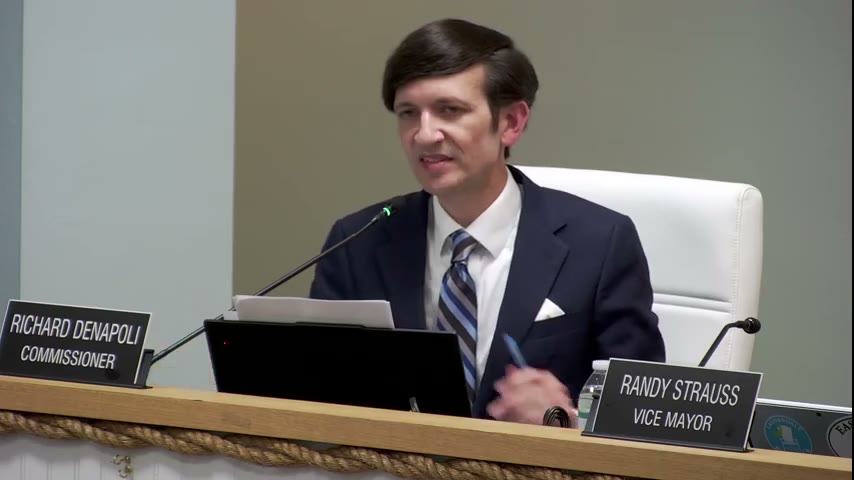 “Some have suggested that the Florida Legislature was somehow misled about a resolution passed by this Commission. That is simply incorrect… There is no misinformation to the Legislature… Others have suggested this process was somehow hidden or secret, and that is not true.”
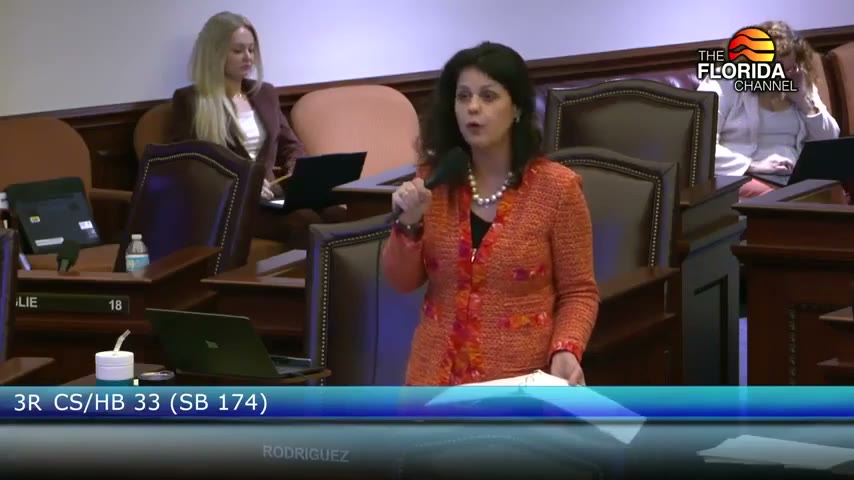 “The Town of Lauderdale-by-the-Sea adopted a resolution approving this designation by a vote of three to two at their commission meeting on December 9th of 2025.” The Senate passed the bill 27–10 on that statement. It was the only time the Senate considered our road.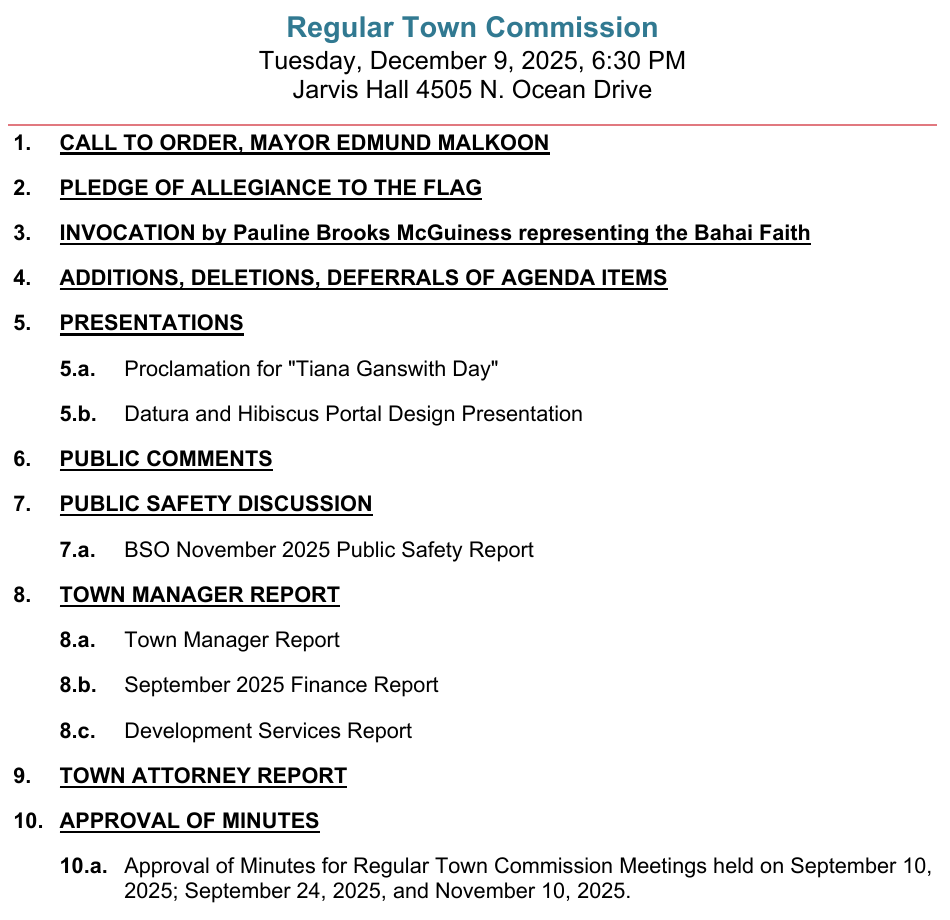
 December 9 was only the minutes. The Commission approved the written record of earlier meetings, 4–0. No resolution. No vote on any road. DeNapoli said so himself on March 10: December 9 “refers only to the town commission’s later approval of the meeting minutes.”
| On the agenda | Item 10.a, approval of minutes. |
| The vote | The minutes, 4–0. Motion by Poulopoulos, second by DeNapoli. |
| Not on the agenda, not voted | Any resolution. Any road. Any designation. A resident who tried to raise the sign was told it was not part of the item. |
So which is it?
Two possibilities, and on March 10 he denied both.
1. The Senate was told something untrue. Then “there is no misinformation to the Legislature” is false.
2. The Senate was told the truth. Then the Town “adopted a resolution” for a state road that appears on no agenda, in no minutes and at no public meeting, and “nothing hidden or secret” is false.
That night he offered a third answer: the Senate meant the September 10 resolution, and December 9 was only the date the minutes were approved. Read that resolution. It is about Sea Grape Drive, a Town street. It does not mention Commercial Boulevard. The Senate was told the Town approved “this designation,” the state road in the bill. State law requires a resolution “in support of the particular honorary designation.” A resolution about one road is not a resolution about another. The third answer is the first answer.
The dates tell the rest.
December 9, 2025. A resident tries to raise the sign at the meeting and is told it is not part of the item. The Commission approves minutes, 4–0.
March 3, 2026. He tells the Sun Sentinel the state approval “has to come through us at the local commission.”
March 4, 2026. The Senate is told the Town already approved it, on December 9. The Senate passes the bill 27–10.
March 10, 2026. The Commission votes on the state road for the first time, 3–2.
March 15, 2026. Our state representative says the request came in a phone call from DeNapoli, and that he sent him to the bill’s sponsor.
By his own words on March 3, the Town had approved nothing when the Senate was told, the next day, that it had.
If someone tells you the December 9 date was only a slip, set the date aside. The Senate could have been told what was true at the time. Our state representative said it himself, later, to the Sun Sentinel: “there has been a hubbub about the Sea Grape renaming, and they wanted to do this in case they take that down.” Instead the Senate was told only that the Town had approved it, and passed the bill 27–10. You decide whether it would have passed on the first version.
Either the Senate was told something untrue, or the Town’s business was done outside a public meeting. He denied both. His explanation, that the Senate meant a resolution about a different road, is the first answer in other words.The record, side by side
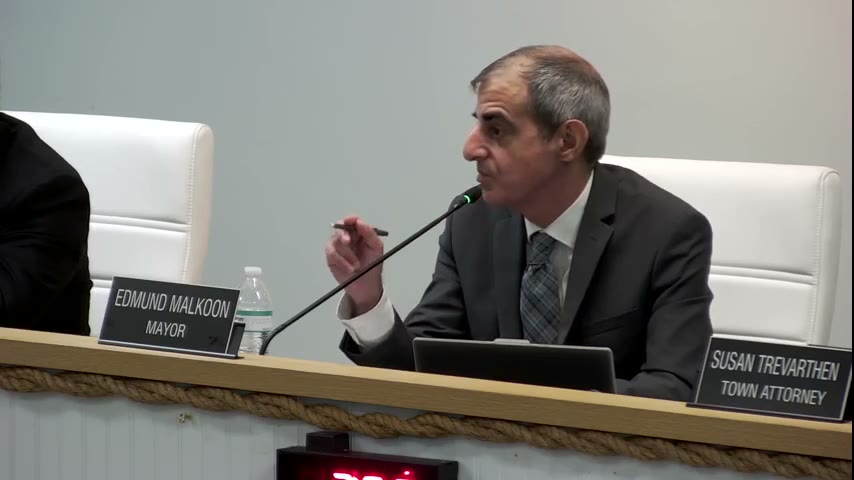 “It means it’s basically gonna happen if the governor signs it, correct, regardless of a yes or no tonight?”
He told you your vote could not stop the signs. Under state law, the signs could not go up without it. Then he voted yes.
Fifty-five residents had just spoken. Then, moments before the vote, the Mayor told the room the outcome did not depend on the Commission. To be exact: the name in the statute would exist either way. The signs on Commercial Boulevard would not. Under section 334.071(3), the state may put up the markers only after the Town passes a resolution in support, so the signs depended on this vote and on nothing else. You may have wanted the state sign. You still deserved to be told, from the dais, what your Commission’s vote actually decided.
If they can tell residents the wrong thing about a vote on a sign they could simply have voted for, they can do it about the height limits. Why put eight amendments on the ballot that make you slower to petition, rarer to vote, and unable to remove a commissioner here in Town Hall?Whether you agree with the sign or not
They had the three votes they needed. None of this was necessary to get the sign.
Three commissioners is a majority. The Town Manager had prepared the item the way new items were handled: under New Business, discussed first, with the staff report attached, and voted on at a later meeting, which would have given the residents of Sea Grape Drive time to be notified. They could have done it that way and said plainly: we know what the staff report recommended, and we are setting it aside to honor the President. Residents would have argued, lost 3–2, and gone home. Some of us would have been angry. All of us would have had the chance to be heard, and all of us would have known exactly what was happening.
Instead: the practice that put staff’s report in front of you ended that night, and the report never reached you. The Legislature was told the Town had decided when it had not. From the dais, moments before the vote, the room was told the state signs would happen regardless of that night’s vote. Under state law they could not go up without it. Commissioner DeNapoli added that the markers still had to come before the Commission for approval; the Mayor said okay and moved to the vote. And a fourteen-year employee was fired without cause and called a political appointee, in a town whose charter makes every seat on that dais nonpartisan.
That is not how people you can trust with power behave. It was never about the name on the sign. It is about what they were willing to do to get it, and what they may be willing to do next.The narrowest defense, and what it leaves out
Nothing required it. Just because you can does not mean you should.
It is fair to state their defense at its strongest. As far as we can find, no Town rule required the request to go under New Business for discussion first. No rule required the staff report to be attached. No law required notice to the residents of Sea Grape Drive, and a co-designation changes no one’s address. Commissioner DeNapoli says all procedures were followed. We know of no written rule that says otherwise.
Here is what that leaves out. The Town’s own report, four months before the vote, had the item set for New Business with discussion first, and recommended notifying every property owner on the street. On September 5 the request went under Resolutions for a vote the same night, the report was not attached, and no notice was sent.
None of it was required. All of it was in the Town’s own staff report, four months before the vote. Just because you can does not mean you should.Evidence: the May 2025 staff report, item 13.d, “Agenda Section: New Business” (PDF) · the September 10 packet, item 18.e under Resolutions (PDF) · May 13 minutes (PDF)
This is the short version. The whole paper trail, every document linked, is next.
The record · Sea Grape Drive
$17,489 of your money for a sign a political party wanted. Nobody asked you.
In September 2025, Commissioner Richard DeNapoli, who chaired a national political party's county organization before taking a seat on our non-partisan commission, asked the Town to co-designate Sea Grape Drive at Commercial Boulevard after a sitting president (Resolution 2025-42). Why that corner? The minutes record his answer: the location was requested because a political party's county headquarters building sits there. The people who live on Sea Grape Drive got no notice from Town Hall; the party, meanwhile, emailed its whole county list to turn supporters out. Neighbors filled Jarvis Hall for three hours anyway, and of the 37 residents who spoke, 33 were against it. Residents who visited 50 local businesses found 46 against it. Dozens more stood on the corner with signs that said No Politics in Paradise. It passed anyway, 3–2. Vice Mayor Strauss and Commissioner Graziano voted no. Mayor Malkoon voted yes.
This was never about the president. Plenty of neighbors who voted for him stood on that corner with a sign. They were protesting three Commissioners deciding, with no notice to the people who live on that street, to put a party's mark on the entrance to their town — and then going around them when they objected. If it had been the other political party's headquarters on Sea Grape Drive, we'd have been on the same corner.
The sign is the smallest part of this. To get it through, the same commissioner objected to the Town's practice of a staff report first, and the Commission dropped it, the Mayor agreeing. Nothing in the charter required the report; it was simply how the Town had always done it. Five weeks before the sign passed, the Town Manager who had explained that practice was fired without cause, 4–1, on a motion by the Mayor, seconded by Commissioner Poulopoulos. When residents petitioned to put street names to a vote, he called our state representative, and our stretch of Commercial Boulevard, a state road, went into a state bill overnight on the claim that the Town had already decided. It hadn't. Then the Mayor told the room that the Commission's own vote could not stop the state signs. Under state law, the signs could not go up without it, and Commissioner DeNapoli said so from the dais moments later. Every step where you and the state's own lawmakers were misled is below, with the document.
The signs went up at Sea Grape Drive and Commercial Boulevard. Cost to the Town: $11,729, a figure pulled from Town records and read into the March 24, 2026 Commission minutes.
Six months later, on March 10, 2026, the same 3–2 majority voted to take those signs down again, because the same name had been put into a Tallahassee bill for Commercial Boulevard instead (HB 33, signed June 25, 2026), and most residents, and even some Commissioners, didn't learn of it until it was already moving. The Sea Grape Drive signs finally came down on August 28, 2026, less than a year after they went up. The Town Manager's estimate for the removal work: $5,759.76. You paid to put them up and you paid to take them down: $17,489 in all.
Residents collected signatures for a charter amendment so that voters decide what our streets are named. It never reached your ballot: once the name was moved to a state road, no Town charter change could touch it. The Commission's eight amendments did reach your ballot. That tells you whose town they think this is.
- $17,489
- Your money: $11,729 to put the Sea Grape Drive signs up, $5,759.76 (Town Manager's estimate) to take them down.
- 3–2
- The vote to put them up (Sept 10, 2025) and the vote to take them down (Mar 10, 2026). Same three yes votes both times.
- 33of 37
- Residents who spoke at the September 2025 meeting and opposed it. Businesses canvassed: 46 of 50 against.
- 3 days
- From the vote to the three yes votes being recognized at a county party event for co-designating the street.
- 4–1
- The vote to fire the Town Manager without cause, July 29, 2025, five weeks before the sign passed. Fourteen years with the Town. Motion: Malkoon. Second: Poulopoulos. No: Strauss.
- 0
- Town agendas that mentioned Commercial Boulevard before the state bill passed both chambers. The Legislature was told the Town had already voted.
How it was done · the paper trail
The Town had a process. Its own staff wrote it down. Here is what happened to it.
Every step below is tied to a Town document, a Legislature document, or video. Where we quote, it is verbatim. Where the source is a record obtained by public records request, it is marked † and we will share it on request. Read the documents yourself; they are linked at each step.
How Town Hall is supposed to work, and what changed
Town business is public business. When a commissioner wants a vote on something, the practice was that Town staff looked into it first and put a written report in the agenda packet: what it costs, who it affects, which Town policies apply. Staff work for the Town, not for any commissioner. You could read the report before the meeting. So could the other four commissioners. Nobody had to take one person's word for anything.
On May 13, 2025, Commissioner DeNapoli objected to that, and the Mayor went along. Now the commissioner who wants the vote writes the background material himself. Staff no longer checks it first. Whatever he says it costs, whoever he says asked for it, that is what you see. The sign went through the new way: no cost estimate, no notice to the street, and a memo that said the request was to match the location of a political party's office. Anything a commissioner brings forward now works the same way.
This is not a Republican or Democratic problem. It is a check on power, and it is gone. If you believe government should be watched, this was the watching. A commission that writes its own facts can do anything it wants. So can the next one.
Ask whether you would want that rule in place the day three people you did not vote for hold the majority.-
Apr 23, 2025
Commissioner DeNapoli submits an agenda-item request to Town staff with a "Sample Resolution for a Street Name Change." Nothing is said publicly, and the item does not appear on any Town agenda until September 5. The sample resolution already contains a clause about a political party's office on the corner.†
The party’s office was in the plan from the first page.
 The sample resolution DeNapoli handed staff in April 2025. The clause about the party's office was there from the start.
Evidence: the request and sample resolution, Exhibits 1–2 of the staff report (PDF)
The sample resolution DeNapoli handed staff in April 2025. The clause about the party's office was there from the start.
Evidence: the request and sample resolution, Exhibits 1–2 of the staff report (PDF)
-
May 6, 2025
The Town Manager sends DeNapoli a draft staff report for the May 13 meeting, Agenda Item 13.d. It says the Town has no policy for naming streets, and suggests borrowing from the Town's policy for naming Town properties and facilities (Resolution 2023-59): a supermajority vote; notice to every property owner on the street; that some towns require approval of the affected residents; and that under the policy a sitting public official is ineligible and names should go only to people "deceased or in their twilight years." The Town's own application form adds that the applicant bears all costs. Neither the report nor the item appears on the May 13 agenda. The 255-page packet contains no mention of it.†
Staff wrote the report. The public never saw it.
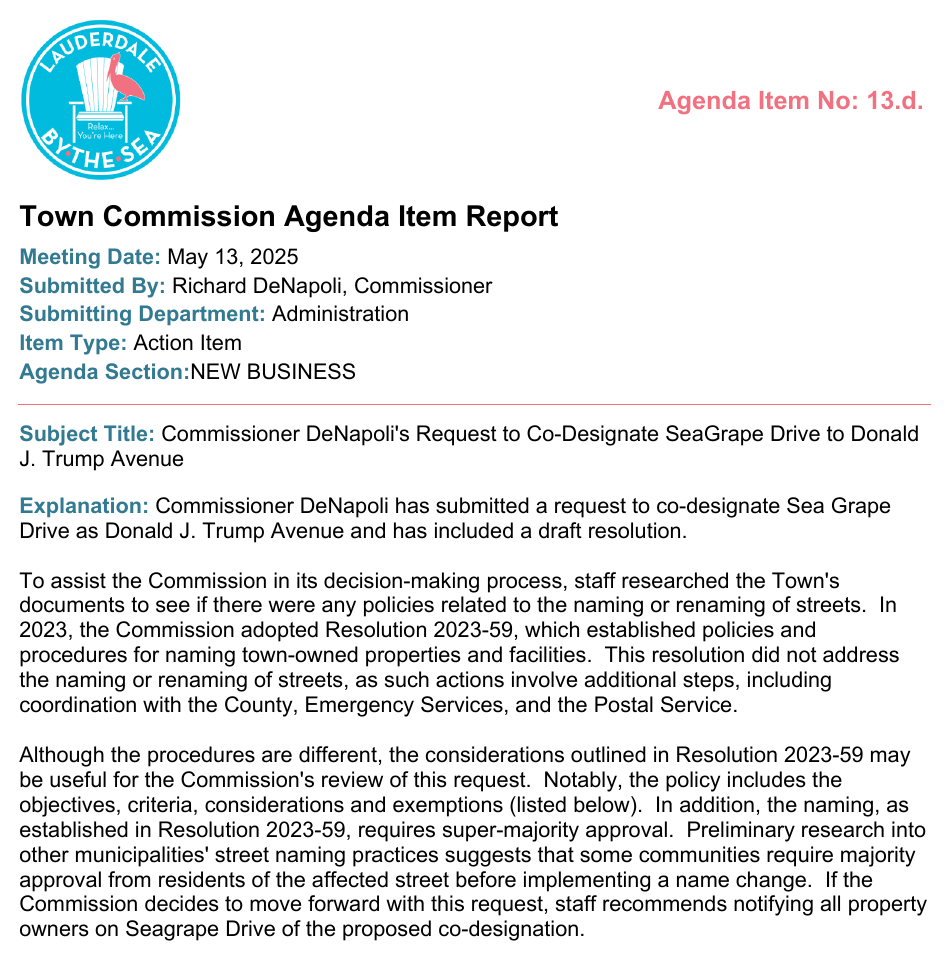
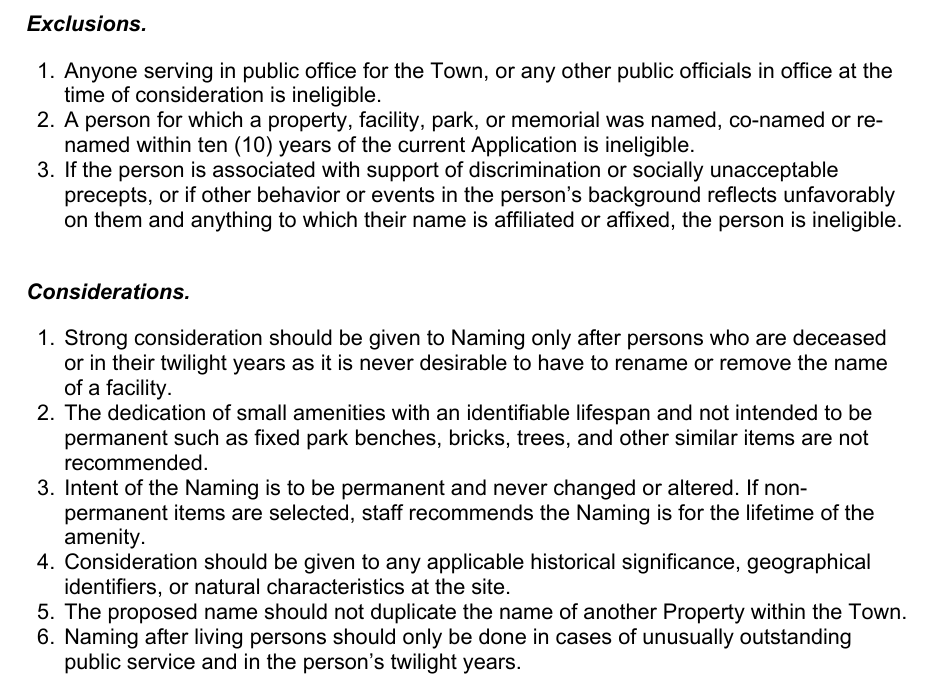 The buried report. Left: page 1, with the recommendation to notify every property owner. Right: the exclusions and considerations staff said should guide the decision.
Evidence: staff report, Item 13.d, 12 pp. (PDF) · May 13 agenda as posted, no such item (PDF)
The buried report. Left: page 1, with the recommendation to notify every property owner. Right: the exclusions and considerations staff said should guide the decision.
Evidence: staff report, Item 13.d, 12 pp. (PDF) · May 13 agenda as posted, no such item (PDF)
-
May 13, 2025
On the meeting video, the Town Manager describes the Commission's existing practice for commissioner items: staff gathers the information first, then the Commission decides. She begins "so one of the items was Commissioner DeNapoli—", catches herself, and switches to a different example of his. Commissioner DeNapoli then argues that commissioner items "should just come up for a vote" and that "you would never want to put the commissioners in a subordinate position to staff." The outcome, at 52:54 and in the minutes: from now on staff prepares only an agenda memo, and "the proposing Commissioner would prepare any supporting documentation." That is the change that kept the staff report out of every agenda packet that followed. In plain terms: a commissioner who wants a vote now writes his own background material, and staff no longer checks it first. Nobody on that dais is above the Town’s employees, or the residents they both serve.
DeNapoli objected to the Town’s practice of putting a staff report in front of you before a vote, and the Commission dropped it. Mayor Malkoon agreed. From that night on, no one on staff was asked to check a commissioner’s facts before they were put in front of you.
Being given the facts first is not being subordinate. It is being accountable.
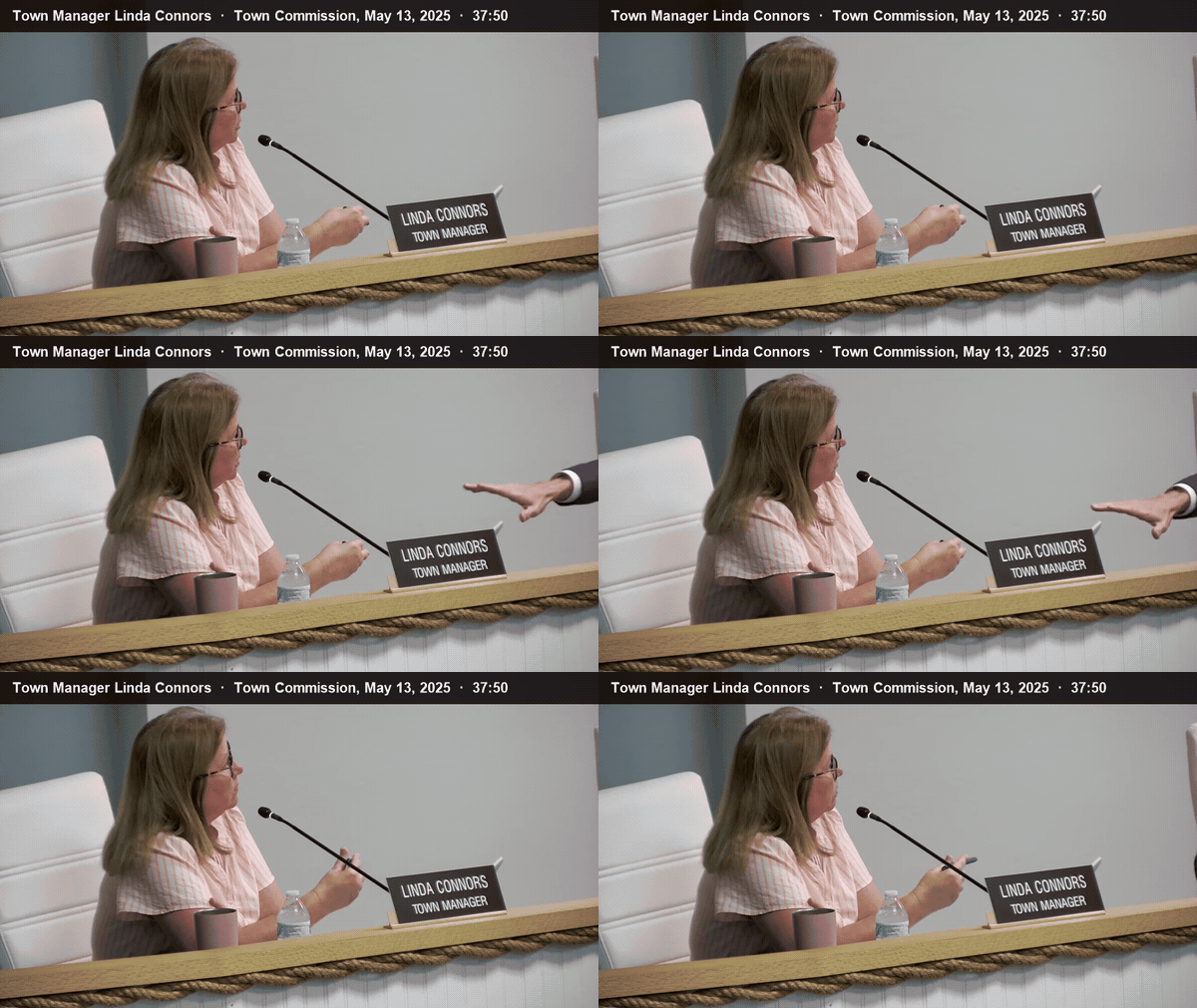 38:50 on the Town’s video. The Town Manager is explaining how items reach the agenda. The hand is Commissioner DeNapoli’s.
She was describing the practice. His hand came up. By the end of the night the practice was gone, and the report on his request never reached the public.
May 13, 2025, one continuous passage, 38:25 to 41:04 on the Town video: the practice as it stood, the hand, and the objection. What replaced it, at 52:55, is a separate 38-second clip. Nothing is spliced. The unedited 37:30 to 53:30 is here in two parts: 37:30 to 45:30 and 45:30 to 53:30.
Evidence: May 13 minutes, pp. 4–7 (PDF) · full meeting video on the Town portal
38:50 on the Town’s video. The Town Manager is explaining how items reach the agenda. The hand is Commissioner DeNapoli’s.
She was describing the practice. His hand came up. By the end of the night the practice was gone, and the report on his request never reached the public.
May 13, 2025, one continuous passage, 38:25 to 41:04 on the Town video: the practice as it stood, the hand, and the objection. What replaced it, at 52:55, is a separate 38-second clip. Nothing is spliced. The unedited 37:30 to 53:30 is here in two parts: 37:30 to 45:30 and 45:30 to 53:30.
Evidence: May 13 minutes, pp. 4–7 (PDF) · full meeting video on the Town portal
- May 27 – Aug 6 Seven regular Commission meetings and a special meeting. The item is on none of the agendas, and neither is the staff report. Nobody brought it back. Evidence: every agenda, May 27 through Aug 6, on the Town portal
- Jul 22, 2025 At a regular meeting, the Mayor reads a statement into the record about the Town Manager. He says he has lost confidence in her leadership and invites the other commissioners to say whether they share his concerns. She answers on the record, and the Town Attorney confirms that her written response to his questions was sent a week earlier. The specifics are a personnel matter between an employer and an employee, and they are not ours to publish. In May the word was “subordinate.” In July it was “insubordinate.” Same idea, two commissioners: the people who work for the Town work for them. Evidence: July 22 minutes, pp. 6–8 (PDF)
-
Jul 29, 2025
A special meeting, called by the Mayor, with one item: the Town Manager. She has been with the Town since 2011 and Town Manager since 2021. Residents speak on both sides; a former Mayor and a Town employee of thirty years speak for her. She tells the Commission she remains committed to residents, the Commission and staff. The Mayor reads his reasons into the record. One of them, word for word: “attempts to limit the Commission’s ability to place items on agenda without our prior consensus, a move, in my view, sought to minimize the legislative authority of this body… This was not a procedural debate. It reflected a broader tendency to consolidate control and restrict the governance role of elected officials.” That is May 13. Commissioner DeNapoli, in the minutes: “it is not uncommon for political appointees such as the Town Manager to be dismissed upon a change in political leadership, as they serve at the pleasure of elected officials.” Our charter says this Commission is nonpartisan. Vice Mayor Strauss: he had “seen no evidence that the Town Manager has made decisions without Commission approval”; a termination without a full and fair discussion he “would view as suspect and politically motivated.” The Mayor makes the motion. Poulopoulos seconds it. Terminated without cause, effective immediately, 4–1, Strauss dissenting. A second motion, 5–0: restrict her email and keys that night. The Town’s press release the next morning thanks her for her service.
One of the Mayor’s written reasons for firing her was “attempts to limit the Commission’s ability to place items on agenda without our prior consensus”. Agenda placement was the subject of the May 13 discussion. It is in the minutes.
He called the Town Manager of a nonpartisan town a “political appointee,” dismissed on “a change in political leadership.” His words.



 From the July 29 minutes. Top left: the Mayor’s reason that points back to May 13. Top right: “political appointees.” Bottom: the vote, and the motion to cut off her email and keys.
Fourteen years with the Town ended in a special meeting called by one man, on the second of another, with a written list of reasons that includes May 13, the night she described the practice of a staff report. Both men are on your ballot.
Evidence: July 29 special meeting minutes (PDF) · the Town’s press release, July 30 (PDF) · meeting video on the Town portal
From the July 29 minutes. Top left: the Mayor’s reason that points back to May 13. Top right: “political appointees.” Bottom: the vote, and the motion to cut off her email and keys.
Fourteen years with the Town ended in a special meeting called by one man, on the second of another, with a written list of reasons that includes May 13, the night she described the practice of a staff report. Both men are on your ballot.
Evidence: July 29 special meeting minutes (PDF) · the Town’s press release, July 30 (PDF) · meeting video on the Town portal
- Aug 12 & 26 Both regular meetings cancelled.
-
Sept 5, 2025
The agenda for Wednesday, Sept 10 is posted with Resolution 2025-42 as item 18.e. The packet for the item is a four-line cover memo and his resolution. The staff report from May is not in it: no policy, no cost, no notice to anyone. The memo says the request "is to coincide with the location of" a political party's county offices. Residents of Sea Grape Drive are not notified by the Town. The registered voters of one party receive a turnout email. The report staff wrote in May, with its five recommendations, is not in the packet.
One political party’s voters got an email ahead of the vote. The people who live on the street got nothing.
The person who put the process in writing was gone. Five weeks later, the sign came through with none of that process.
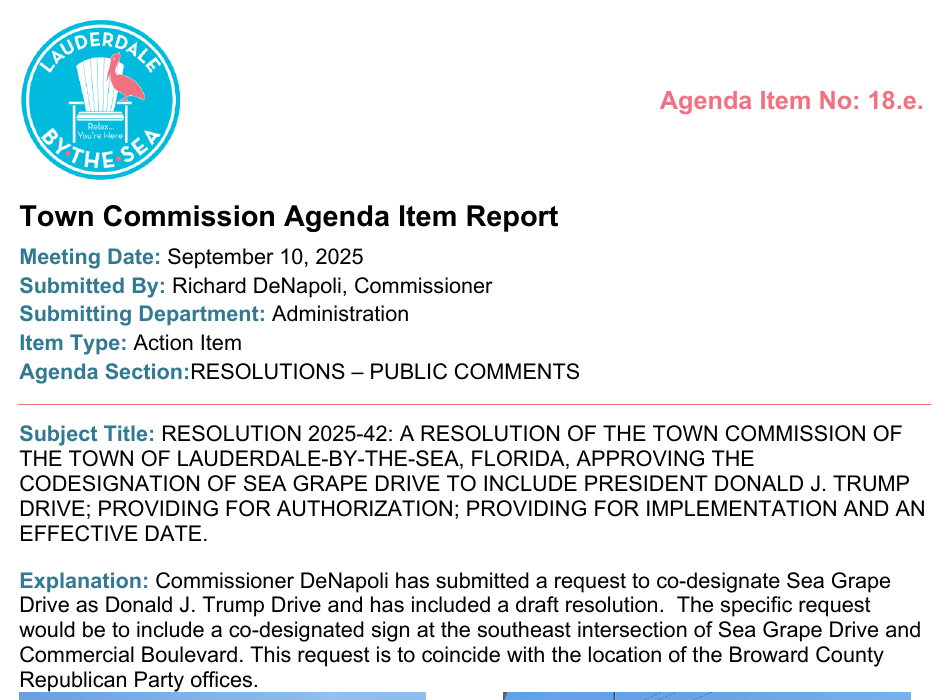 The item as the public first saw it: four months after staff wrote the guidance, with the guidance gone.
Evidence: item 18.e and Resolution 2025-42, from the Sept 10 packet (PDF) · posting time from the Town portal
The item as the public first saw it: four months after staff wrote the guidance, with the guidance gone.
Evidence: item 18.e and Resolution 2025-42, from the Sept 10 packet (PDF) · posting time from the Town portal
- Before the vote The Town's public-relations firm is already working on messaging for the co-designation, before residents have been heard.†
-
Sept 10, 2025
Jarvis Hall, past midnight. 33 of 37 residents against. The minutes record who asked for it:
Chris Marino, representing the Broward Republican Party, advised that he had requested its introduction due to the location of Republican Party headquarters at Sea Grape Drive and Commercial Boulevard.
Commissioner DeNapoli: the location was requested "due to the proximity of" that headquarters. It passes 3–2: Malkoon, DeNapoli, Poulopoulos for; Strauss, Graziano against. 33 of 37 residents said no. A party chairman said yes. Three votes went with the chairman. On video, the person who asked for the sign: “As chairman of the Broward Republican Party… I and many others asked for this resolution to be introduced. Here’s why. Our party headquarters has been located here… We see this not only as a small token of appreciation for our contributions… potentially help smooth the path on larger projects important to the town.”
 From the minutes the Commission approved on December 9. Left: who asked for the sign. Right: the vote.
Evidence: Sept 10 minutes, as approved by the Commission on Dec 9 (PDF)
From the minutes the Commission approved on December 9. Left: who asked for the sign. Right: the vote.
Evidence: Sept 10 minutes, as approved by the Commission on Dec 9 (PDF)
-
Sept 13, 2025
Three days later, Malkoon, Poulopoulos and DeNapoli are recognized on stage at that party's county event for their efforts in co-designating the street.†
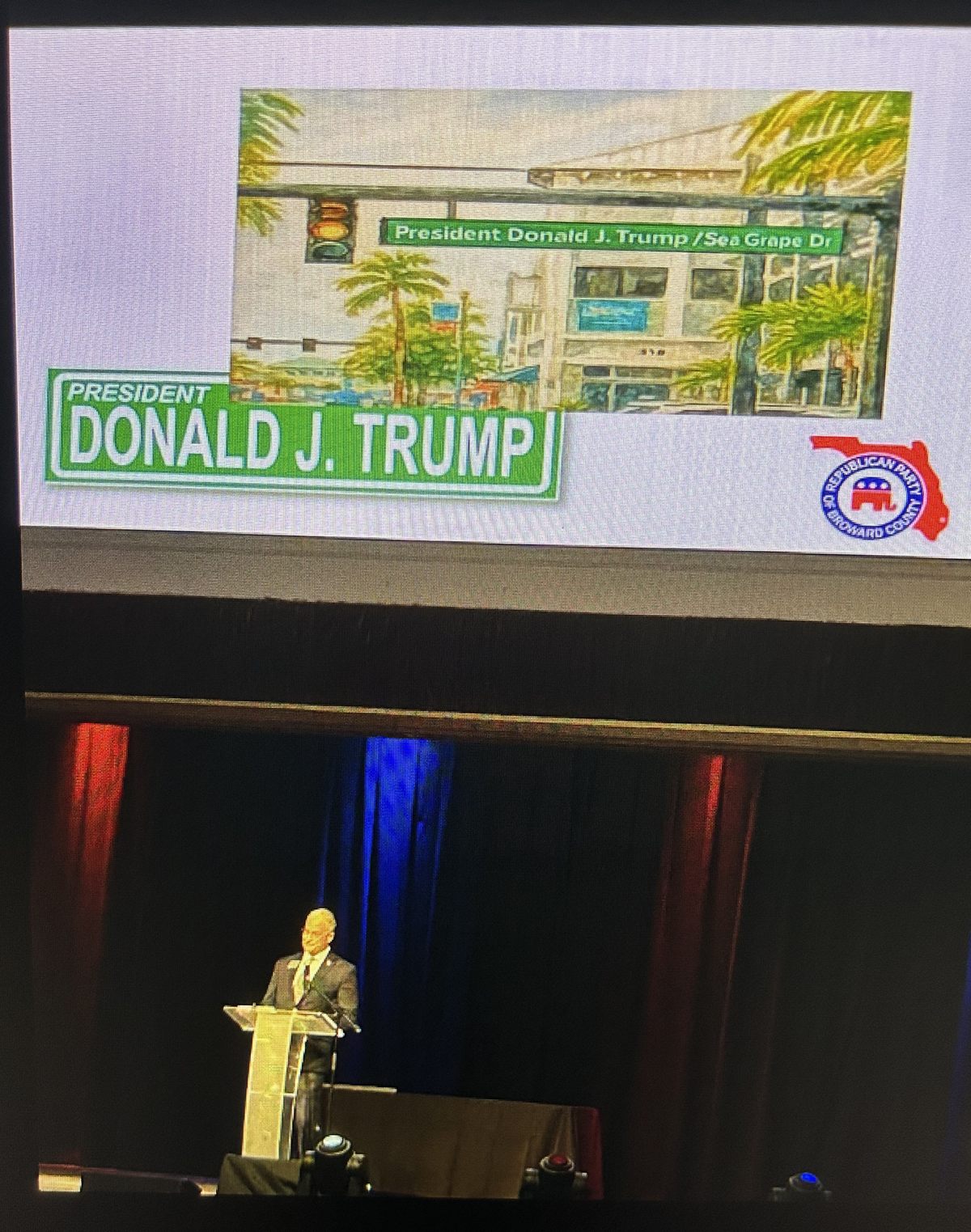
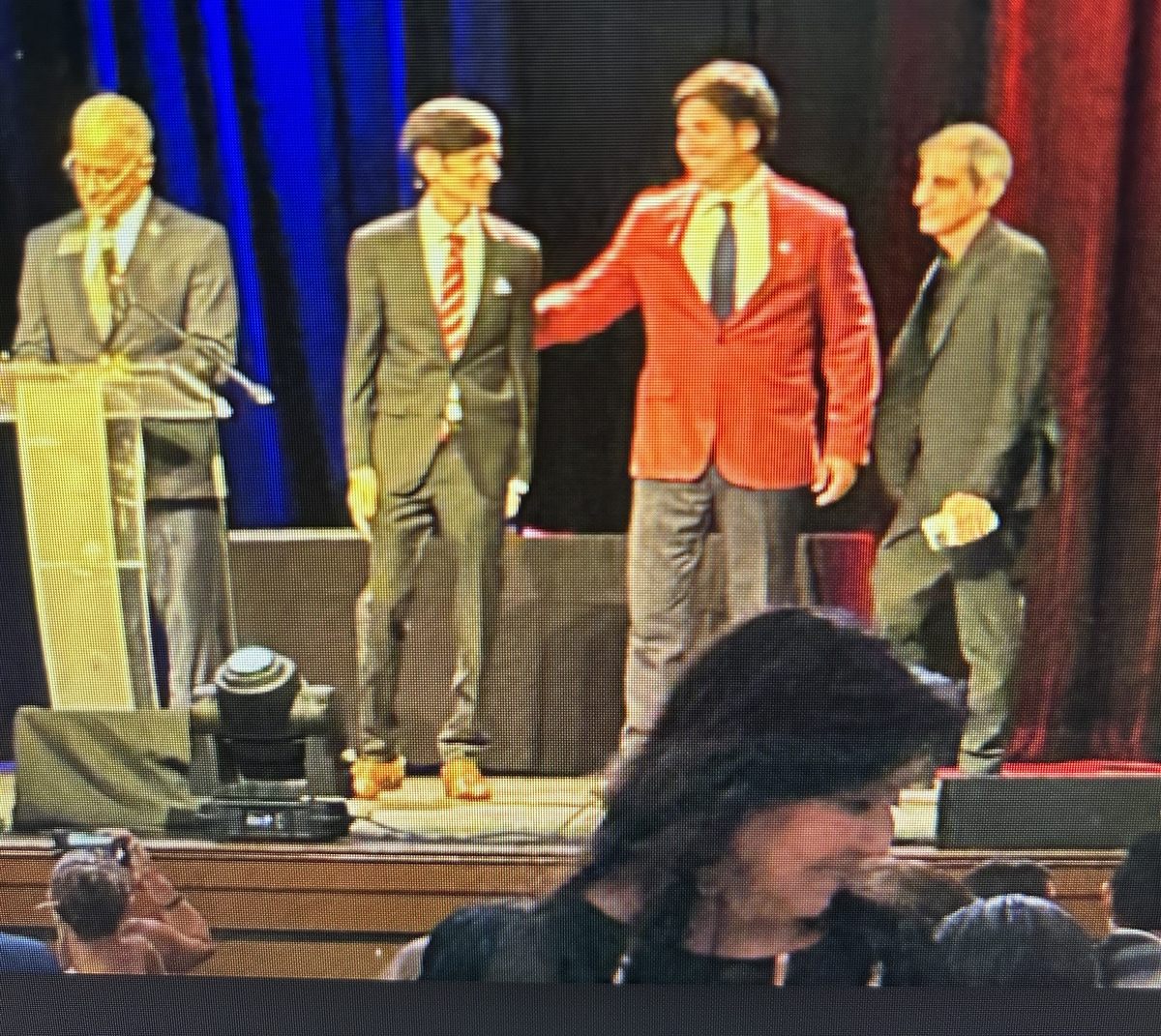 The party's own slide, and the three yes votes on stage, September 13, 2025.
The next time someone tells you residents brought politics into Town Hall, look at this photo. Residents did not bring politics into Town Hall. Three commissioners took Town Hall to a party.
The party's own slide, and the three yes votes on stage, September 13, 2025.
The next time someone tells you residents brought politics into Town Hall, look at this photo. Residents did not bring politics into Town Hall. Three commissioners took Town Hall to a party.
-
Dec 9, 2025
A routine item: the Commission approves the written record (the minutes) of the Sept 10 meeting. Four commissioners are present; the Vice Mayor is excused. The vote is 4 to 0. Nothing about Commercial Boulevard or a state road is on this agenda, or on any Town agenda through Feb 24, 2026. Remember this date. You will see it again.
Evidence: Dec 9 agenda (PDF) · Town agendas for Jan 13, Jan 27, Feb 10, Feb 24
-
Feb 3, 2026, 4:56 pm
In Tallahassee, an amendment is published adding "that portion of S.R. 870/Commercial Boulevard between W Tradewinds Avenue and the eastern terminus" to House Bill 33, a bill that until this moment had nothing to do with Lauderdale-By-The-Sea. The committee hearing is at 1:30 pm the next day. The House's own staff analysis records this as the only change made to the bill.
Twenty hours’ notice, for a road the Town had never discussed.
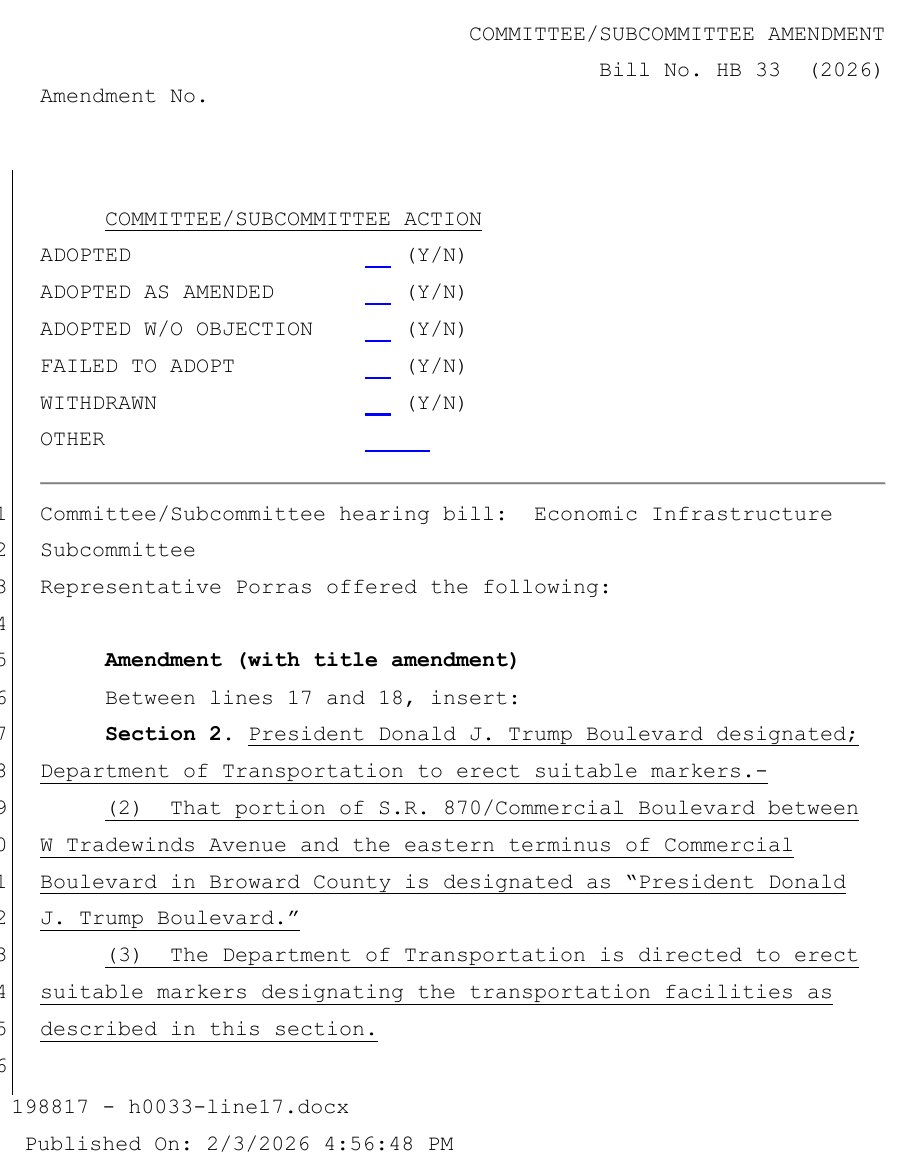 Evidence: Amendment 198817 (PDF) · House staff analysis, Bill History (PDF)
- Feb 4, 2026 The House subcommittee, chaired by our own state representative, adopts the amendment by voice vote in under two minutes, with no public testimony. The sponsor tells the committee Commercial Boulevard is "already designated." The chair tells a member the Town has "decided they would rather designate the state portion of the road." The Town had decided no such thing. No Town agenda had ever mentioned moving the name to Commercial Boulevard. Our own representative told his committee the Town had decided. It had not. Thirty-two seconds: the chair explains that Sea Grape was "a city road" and that the Town has "decided they would rather designate the state portion of the road." The Town's first vote on that road was 34 days later. The clip closes with what he told the Sun Sentinel five weeks after this hearing. Full five-minute excerpt ("already designated" at about 2:00). Source: full meeting, The Florida Channel, 30:05–34:55
- Feb 10, 2026 House Commerce Committee. The sponsor presents the bill without mentioning our road at all. Only when a Broward representative asks whether the bill contains any other roads does he say the Town named the road but "due to some clerical issues, we're ensuring that their resolution is still sound and this bill just codifies that change." There were no clerical issues. The Town had never voted on Commercial Boulevard. Our own representative, in debate: "one of the amendments was to add the road in Lauderdale-by-the-Sea." There were no clerical issues. The Town had never voted on Commercial Boulevard. Left: the sponsor, asked whether there are other roads in the bill: "clerical issues… just codifies that change." Right: our representative in debate: "one of the amendments was to add the road in Lauderdale-by-the-Sea." Source: full meeting, Florida House
- Feb 25, 2026 House floor. The sponsor: the bill is "codifying a decision that was made by a local municipality." Rep. Robin Bartleman, of Broward, answers that "not all of Broward County nor the Commission have been able to vet this." It passes 82–30 with no floor amendment. “Codifying a decision” the Town had never made. 82 to 30. Source: full session, The Florida Channel · vote at p. 485 of the House Journal
-
Mar 3, 2026
The day before the Senate vote, Commissioner DeNapoli tells the Sun Sentinel the bill "would give the local commission options to consider in the event the bill is signed into law since the approval has to come through us at the local commission." In other words: not yet approved. The same article notes that "it's not entirely clear how the Commercial Boulevard designation made its way onto the House bill" and that none of its sponsors are from Broward.
Not yet approved, in his own words. The next day the Senate was told it was.
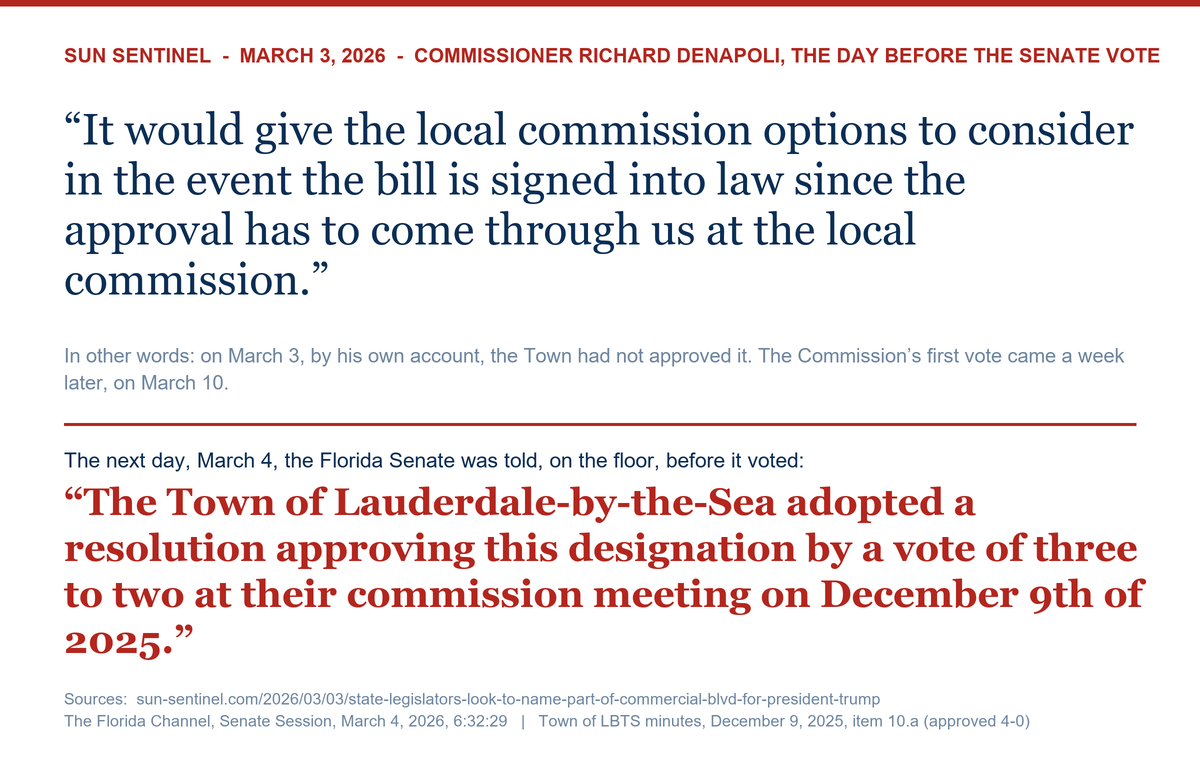 March 3, in his own words: not yet approved. March 4, what the Senate was told.
Evidence: Sun Sentinel, March 3, 2026
March 3, in his own words: not yet approved. March 4, what the Senate was told.
Evidence: Sun Sentinel, March 3, 2026
- Mar 4, 2026 The Florida Senate. No Senate committee ever looked at our road; this is the only time the full Senate considers it. The senator closing for the bill says the Town "adopted a resolution approving this designation by a vote of 3 to 2 at a commission meeting on December 9th of 2025." Scroll back up to December 9. There was no resolution that night. The Commission approved the written record of an earlier meeting, 4 to 0, with the Vice Mayor absent, and never mentioned Commercial Boulevard. The Senate passes the bill 27–10 on that statement. Wrong meeting. Wrong road. Wrong vote count. The Senate passed it anyway. Florida Senate, March 4, 2026, the sponsor's closing, 6:32:30 on the Senate video. Cut to the statement. Compare: the Dec 9 agenda (PDF) · Source: full session, Florida Senate
-
Mar 10, 2026
Six days after the bill has passed both chambers, the Commission votes 3–2 to "support" it. Fifty-five people sign up to speak. Before they do, Commissioner DeNapoli addresses "some false claims that I've seen circulating":
Some have suggested that the Florida Legislature was somehow misled about a resolution passed by this Commission. That is simply incorrect. First of all, the Legislature knows about our local sign and referenced its desire to codify our earlier local vote.
And:There is no misinformation to the Legislature… Others have suggested this process was somehow hidden or secret, and that is not true.
The "earlier local vote" was for Sea Grape Drive, a Town street. The Senate had been told six days earlier that the Town approved this designation on December 9. The "compromise": the Sea Grape signs come down once the state markers go up. March 10, 2026, one continuous passage, 26:02 to 27:42 on the Town video. His words, the record beside them, and what the committee chairman said five days later. Moments before the vote, the Mayor to Commissioner DeNapoli: “It means it’s basically gonna happen if the governor signs it, correct, regardless of a yes or no tonight?” Florida law says the opposite. Section 334.071(3): the state may put up markers only after the city commission passes “a resolution in support.” This vote was that resolution. DeNapoli, same minute: “it has to come before the local Commission as a requirement for approval.” They told residents the vote could not stop it. Under state law, the signs could not go up without it. Then three of them voted yes. They called it a compromise: the state sign in exchange for taking down the Sea Grape sign. But the Commission put the Sea Grape sign up; it could take it down any night it chose. Without this vote, the state sign could not go up at all. The real choice on March 10 was Trump Boulevard or neither. They told you it was Trump Boulevard or Trump Drive. They told you your vote could not stop it. Under state law, the signs could not go up without it. Then three of them voted yes. The supporters were told the purpose in writing. Residents were told it was a compromise.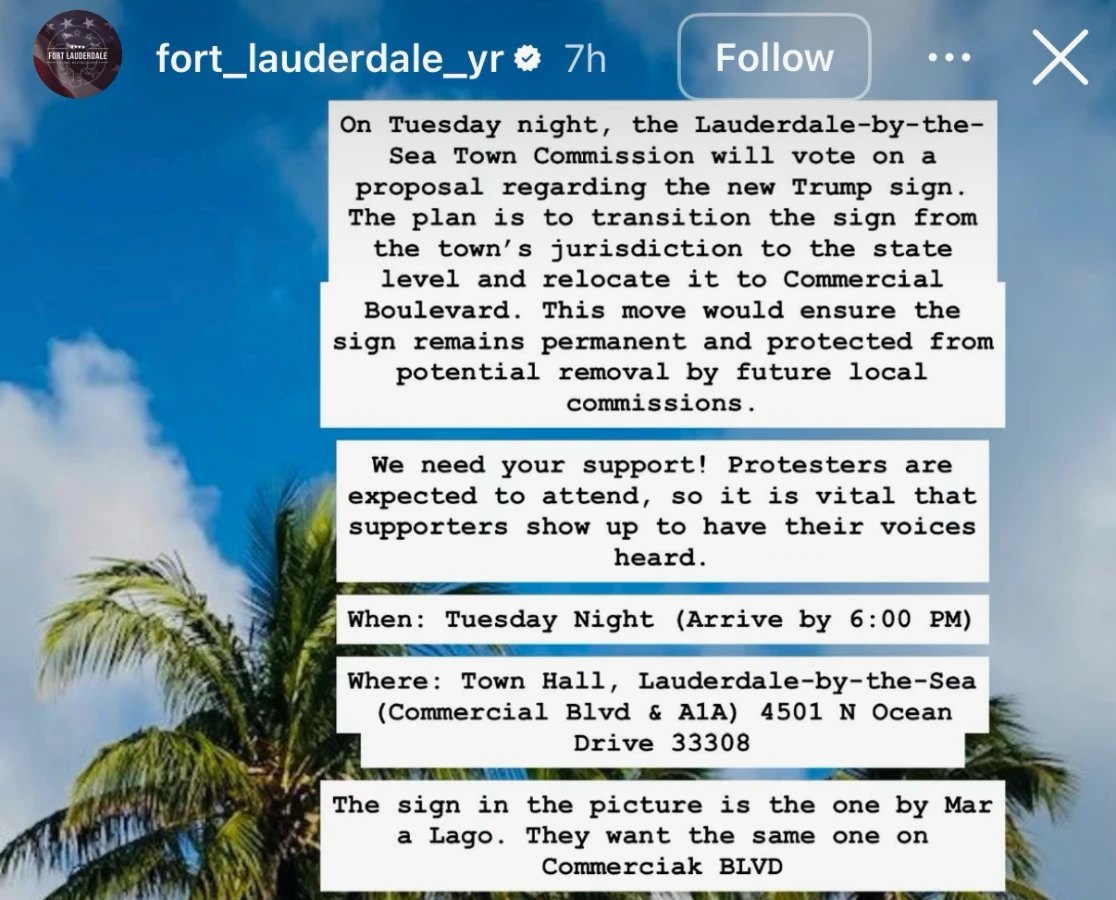 The day before the vote, a political party’s youth club posted a call for supporters to attend and explained the plan in its own words: move the sign “from the town’s jurisdiction to the state level” so it “remains permanent and protected from potential removal by future local commissions.” That is the plan as its supporters were told it. From the dais, residents were told it was a compromise. Fort Lauderdale Young Republicans, Instagram story, March 9, 2026 (screenshot).
Same meeting, the Mayor: “Regardless of how an idea originates, nothing becomes policy unless this commission approves it at a public meeting.” The bill had passed both chambers six days earlier. His next sentence: “The state designation will move forward.”
Evidence: Mar 10 minutes, p. 4, p. 10 and pp. 11–12 (PDF) · s. 334.071(3), Florida Statutes · full meeting video on the Town portal
The day before the vote, a political party’s youth club posted a call for supporters to attend and explained the plan in its own words: move the sign “from the town’s jurisdiction to the state level” so it “remains permanent and protected from potential removal by future local commissions.” That is the plan as its supporters were told it. From the dais, residents were told it was a compromise. Fort Lauderdale Young Republicans, Instagram story, March 9, 2026 (screenshot).
Same meeting, the Mayor: “Regardless of how an idea originates, nothing becomes policy unless this commission approves it at a public meeting.” The bill had passed both chambers six days earlier. His next sentence: “The state designation will move forward.”
Evidence: Mar 10 minutes, p. 4, p. 10 and pp. 11–12 (PDF) · s. 334.071(3), Florida Statutes · full meeting video on the Town portal
-
Mar 15, 2026
The Sun Sentinel Editorial Board publishes how the amendment happened, in the chairman's own words:
I did have a phone call from Commissioner DiNapoli. He asked what they could do about it. Apparently there has been a hubbub about the Sea Grape renaming, and they wanted to do this in case they take that down or something.
He "directed DiNapoli to Rep. Juan Porras," the bill's sponsor. The "hubbub" was the residents' petition. The editorial's conclusion: "To undercut the petition drive, the town quietly asked the Legislature to name part of Commercial Boulevard, a state road… neutering the charter effort." One phone call, to get around a residents’ petition.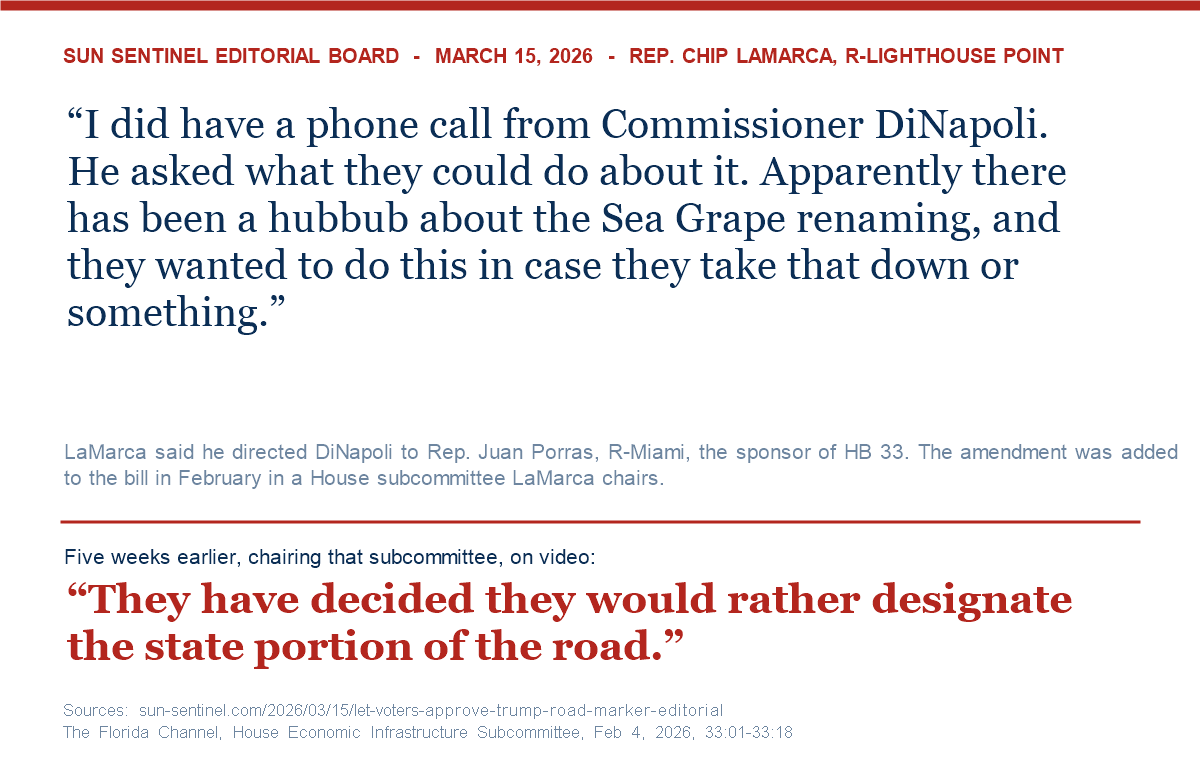 Evidence: Sun Sentinel editorial, March 15, 2026 · full text, as retrieved
-
Mar 24, 2026
A resident reads the cost of the Sea Grape signs into the record: $11,729. The Town’s own naming application, the one staff pointed to in May, says the applicant bears all costs. The Town paid.
$11,729 of your money for a sign a political party asked for. The Town’s own form says the applicant pays.
 The cost, read into the record.
Evidence: Mar 24 minutes, on the Town portal
The cost, read into the record.
Evidence: Mar 24 minutes, on the Town portal
-
Apr 14 & 28, 2026
Residents enter the buried May 2025 staff report into the public record. The Town Attorney responds that the Town's naming policy "does not apply to street names" and "specifically excludes streets." Which is exactly the point: the Town had no rule for streets at all, staff wrote one, and it never reached the public. Commissioner DeNapoli says all procedures were followed. Mayor Malkoon, per the minutes, "discouraged further discussion of the co-designation at public meetings."
Residents asked why the staff report was hidden. The Mayor’s answer was to stop asking.
April 28, 2026, closing public comment. On video: “Let me just boil this down. It’s very simple. You just don’t like the name that’s on the sign… to keep bringing this up for the next six months, come on.”

 Left: the Town had no rule for streets at all. Right: how the minutes recorded the Mayor's reply.
Evidence: Apr 14 minutes (PDF) · Apr 28 minutes, pp. 2 and 13 (PDF)
Left: the Town had no rule for streets at all. Right: how the minutes recorded the Mayor's reply.
Evidence: Apr 14 minutes (PDF) · Apr 28 minutes, pp. 2 and 13 (PDF)
- Jun 25 – Aug 28 The Governor signs the bill June 25. The Sea Grape Drive signs come down August 28. The Town Manager's estimate for the removal work: $5,759.76. Total so far: $17,489. The state designation on Commercial Boulevard stays. The residents' charter amendment never reached the ballot: once the name was moved to a state road, no Town charter change could touch it. $17,489 of your money to put the signs up and take them down. The state sign stays. The residents’ petition never reached the ballot.
What that adds up to
- The Town's own staff wrote a report. It never reached a public agenda. The practice of a staff report ended that same night.
- The Town Manager who described that practice was fired without cause five weeks before the sign passed, and one of the Mayor's written reasons was “attempts to limit the Commission’s ability to place items on agenda without our prior consensus”.
- The outcome was decided before the public was allowed to weigh in, and public opinion was managed, not asked for.
- The Legislature was told five times, by three different legislators, that the Town had already voted to put the name on Commercial Boulevard. It hadn't. The Town's first vote came six days after the bill passed.
- This was a party project, not a town decision, and when residents objected, the same three votes took it to Tallahassee.
- Then, moments before the vote, the room was told the state sign would go up regardless. State law says the markers could not go up without that vote, and Commissioner DeNapoli said so from the dais.
Two of those three votes, Mayor Malkoon and Commissioner Poulopoulos, are on your ballot November 3. So are the eight charter amendments they and Commissioner DeNapoli put there.
This is not over
The state signs are up. Three votes can take them down.
State law made the Town's resolution the condition for those signs. What a Commission gave, a Commission can take back. A new Commission can:
- Rescind the March 10 resolution and formally ask the Florida Department of Transportation to take the markers down.
- Put it to you. A town vote on whether any road in Town, state road included, gets a person's name.
- Ask Tallahassee to repeal it in 2027, with the Town's request on the record.
What the chairman said
The amendment that moved the name to a state road was adopted in a House subcommittee chaired by our own state representative. Here is what he told that committee, and what he told the Sun Sentinel five weeks later. Both are on the record. We add nothing.
"It's not the county commission, it's the Town of Lauderdale-by-the-Sea. It was a different road that was a city road, Sea Grape. And they've decided they would rather designate the state portion of the road."Watch (32 sec) · The Florida Channel, 33:01–33:18
"I did have a phone call from Commissioner DiNapoli. He asked what they could do about it. Apparently there has been a hubbub about the Sea Grape renaming, and they wanted to do this in case they take that down or something."Sun Sentinel editorial, March 15, 2026
"Some have suggested that the Florida Legislature was somehow misled about a resolution passed by this Commission. That is simply incorrect… There is no misinformation to the Legislature… Others have suggested this process was somehow hidden or secret, and that is not true."Watch (1:40) · minutes, p. 4
- Who decided: not the Town. One commissioner, by phone. No Town agenda mentioned Commercial Boulevard until March 10, 2026, thirty-four days after the hearing. Dec 9 agenda · every agenda since
- Why: the "hubbub" was residents collecting signatures for a charter referendum. Moving the name to a state road put it beyond the reach of any Town vote. The Editorial Board's words: "To undercut the petition drive, the town quietly asked the Legislature… neutering the charter effort."
- What the Legislature was then told: Feb 10, "just codifies" a Town resolution. Feb 25, "codifying a decision that was made by a local municipality." Mar 4, the Town "adopted a resolution approving this designation by a vote of 3 to 2… December 9th." Senate clip
- What the commissioner himself said the day before the Senate vote: "the approval has to come through us at the local commission." Sun Sentinel, March 3
A committee chair who, by his own account, had taken a phone call from one commissioner about the residents' petition told his committee the Town had decided. The Town had not. The commissioner who made the call then told a packed Town Hall there was "no misinformation to the Legislature" and nothing "hidden or secret." Five days later the chairman described the phone call. That is the whole record, and every word of it is theirs.
The three statements and the documents beside them are in The Record, above.
If you like the sign, this part is for you
Keep the sign if you want it. Look at what you gave up to get it.
You did not vote for any of this. It was done in your name, and here is what it cost you, whether you wanted the sign or not:
- Your right to know what your Town is doing was cut off. Town staff had a simple job: gather the information on an item and put it in front of you before the vote. That is how you found out what was really going on. On May 13, 2025, DeNapoli objected to that practice, the Mayor agreed, and it ended that night. The commissioner asking for the vote now prepares his own materials. That applies to anything a commissioner brings forward: a street name this year, a zoning change or an exception to the height limit next. The facts reach you only if the commissioner who wants your vote decides to show them.
- The street got no notice. The Town never told the people who live on Sea Grape Drive it was coming. Next time it could be your street, co-designated Biden Boulevard on a Wednesday night, and you would read about it afterward. Malkoon, DeNapoli and Poulopoulos are the three votes behind the eight charter amendments that would make it harder for you to stop it: slower petitions, fewer elections, and removal of a commissioner decided in Tallahassee instead of here.
- Your neighbors' petition got a phone call to Tallahassee. When residents gathered signatures so that voters would decide, the answer was to move the sign to a road no Town vote can reach. Next time it could be your petition.
- They said what got the vote done. On March 10 the Mayor told a full room that the state sign was “basically gonna happen… regardless of a yes or no tonight.” State law says the opposite: no marker goes up until the Town Commission votes for it. Asked to confirm, DeNapoli said the markers had to come before the Commission “as a requirement for approval,” and the Mayor moved to the vote. You may have been glad of the result. But the room was told the wrong thing about what its own Commission could do, on video, moments before the vote. If they can do that for a sign you wanted, they can do it for a building you do not.
None of that is about the name on the pole. It is about what three votes learned this year: that they can skip the process, skip the notice, go around a petition, and tell you your vote does not count, and nothing happens to them. The sign is a sign. That lesson is permanent. If it is used again, it may not be about a name. It may be about the one thing every person in this town agrees on.
You have probably said it yourself: keep politics out of Town Hall, follow the rules, and nobody gets to be above them. This is where that gets tested. Not by whether you like the name. By whether the rules still apply when the name is one you like.
The name on a sign will not protect your height limits. Your rights will. Keep the sign if you want it. Do not let them keep the process.Why this matters more than a sign
This isn’t about the sign. It’s about their character.
The sign is down. The way it got there is not. Three commissioners set aside their own staff's process, gave the street no notice, turned out a party's voters, and then let the Legislature believe the Town had voted when it hadn't. They did all of that for a street sign a political party wanted. Ask what they would do for a developer who wants to build above the height limit.
Our height limits are written into the Town charter. The charter is the rulebook residents wrote, and residents are the only ones who can enforce it. We enforce it with three tools: the citizen petition, the regular election, and the right to remove a commissioner here in Town Hall. The eight amendments on your November ballot weaken all three. Whatever you thought of the sign, the sign is gone. The amendments would be permanent.
The point of all of this
If they can take your voice over a street sign, they can take it over the height limits.
Independent, Republican, Democrat, or none of the above: a Town Hall that writes its own facts, skips the notice, and tells you your vote does not count is a problem for every one of us.
Whoever holds three votes next inherits every shortcut these three took. Not because of who they are. Because of what they learned: that they can skip the facts, skip the notice, go around a petition, and tell you your vote does not count, and keep their seats. The eight amendments make sure you cannot take it back.
Remember this on November 3
Two of the three “yes” votes are on your ballot.
- VOTED YES — Mayor Edmund Malkoon, both times. Made the motion to fire the Town Manager. He's asking for your vote for Mayor on November 3.
- VOTED YES — Commissioner Theo Poulopoulos, both times. Seconded the sign and seconded the firing. He's asking for your vote for Seat 1 on November 3.
- VOTED YES — Commissioner Richard DeNapoli, both times. He brought it. His seat comes up in 2028.
- VOTED NO — Vice Mayor Randy Strauss, both times, and the only no vote on the firing. He's running for Mayor. We recommend him.
- VOTED NO — Commissioner John Graziano, both times.
November 3 · Mayor, Seat 1, Seat 2. Vote for these three. Town first. Randy Strauss for Mayor, Howard Goldberg for Seat 1, Patrick Ferguson for Seat 2. And NO on all eight charter questions.
Sources: Sept 10, 2025 agenda packet (Resolution 2025-42); Mar 10, 2026 minutes (Resolution 2026-04); Mar 24, Apr 14 and Apr 28, 2026 minutes; CS/HB 33 (2026), Chapter 2026-183; removal estimate from the Town Manager's written update to residents. Every document linked in the timeline above is an unaltered copy of a public record, served from this site; the Florida Legislature clips are excerpts of the official video. Items marked † are from Town emails, texts, video and documents obtained through a public records request; email us and we'll share them. Speaker and business counts from the No Politics in Paradise organizers' published account. Commissioner DeNapoli's seat is next on the ballot in 2028. Mayor Malkoon's and Commissioner Poulopoulos's are on it now.
What we all agree on
You can disagree about the sign and still agree about this.
We are neighbors, not a party. Some of us wanted the sign. Some of us stood on the corner against it. What none of us signed up for is the way it was done. Set the name aside for a minute and ask whether you agree with four things.
Tell us the truth from the dais.
Whatever you are asking us to accept, say what it is. A vote that decides the outcome should not be described as a vote that cannot. A Legislature should not be told we decided something we never discussed.
Follow the rules you would hold anyone else to.
If the standard is a staff report and notice to the people affected, it applies to your own project too, especially to your own project.
Decide the town’s business here, in public.
Not by phone to Tallahassee, and not by moving a question to a road residents cannot vote on. Local control means the locals.
Nobody on the dais is above the people who work for the town, or the people who live in it.
A fourteen-year employee explaining the process is not being “subordinate.” A resident asking why a report was hidden is not “making it political.”
Every one of those is a conservative principle, a liberal principle, and a neighbor’s principle. This November, one and a half square miles can show that a town can disagree about a president and still agree about how it wants to be governed. Keep the sign if you want it. Keep the rules. Vote NO on all eight, and vote for three neighbors who have committed to putting the residents first.
What's at stake this November
This town stayed small, quiet and independent for fifty years because neighbors kept saying no.
Here is what the same three votes on the Commission have done with your town in the last year — and what they're asking you to approve next.
-
$17,489
Your money, spent putting up and taking down a sign a political party wanted.
Three Commissioners co-designated our corner at Sea Grape Drive because, in their own words on the record, a political party's county headquarters building sits there. It was in the works for five months and posted on a Friday afternoon. 33 of the 37 residents who spoke said no. The signs went up, and less than a year later you paid to take them down.
Their words, next to the record → -
4–1
Fourteen years with the Town. Fired without cause, five weeks before the sign passed.
In May 2025 the Town Manager described, on video, the practice of a staff report before a commissioner's item reaches you. As she began to name one of his items, DeNapoli's hand came up and she stopped; the practice ended that night. In July the Mayor called a special meeting and read his reasons into the record; one of them is that night. Motion: Malkoon. Second: Poulopoulos. Strauss voted no. The sign went through five weeks later without the staff report.
See the minutes → -
8
Changes to the charter residents wrote — all at once.
Longer terms. Weaker term limits. Longer for Town Hall to sit on a citizen petition. Ethics complaints shipped to a state board in Tallahassee instead of settled in front of the neighbors who elected them.
Vote NO on all 8 → -
May→Nov
Move in by May. Run for your Commission in November.
Buried in the "cleanup" amendment: the residency requirement for candidates is cut nearly in half, and "domicile" — your one true home — becomes "residency," a word a part-timer can satisfy. Easier for someone who barely lives here to run here.
See Question 8 →
If they can ignore residents over a street sign, they can ignore residents over the height limits. Not in our paradise. Two of the three yes votes, Mayor Malkoon and Commissioner Poulopoulos, are on your ballot November 3. This isn’t about a sign. It’s about their character.
What we're protecting
Drive north or south and the towers start. Here, they don't.
That's not luck. In 1973 this town decided it would rather have sunrises than skylines and capped new buildings at three stories, something Pompano and Fort Lauderdale never did. Three stories, period. After the north end joined the Town, residents petitioned and voted to extend that limit town-wide, Codrington to Terra Mar, ocean to Intracoastal, and locked it into the Town Charter in 2006. A fourth floor is allowed only oceanfront, where the ground floor is parking instead of people. No commission can raise the limit anywhere else without a vote of the residents.
Fifty years later you can still walk from the sand to Anglin's Square, get a coffee, hear a band on Commercial Boulevard, and wade out to a living reef a hundred yards from your towel. Every one of those things exists because neighbors said no to something that would have made a lot of money for somebody else. Three of the five seats that guard that "no" are on the ballot this fall.
- 1.57 sq mi
- The whole town, Terra Mar to Codrington, ocean to Intracoastal.
- 5–6k
- Year-round neighbors, give or take. More in season.
- 3 stories
- The limit since 1973. Voters took it town-wide and locked it into the charter in 2006. Only a vote of the people can raise it.
- 100 yds
- From the beach to the reef. South Florida's beach-diving capital.
How to help
Small town. Every vote counts, literally.
Town races here are decided by a few hundred ballots. The three votes that gave you the sign are counting on a quiet November. Here's what actually moves the needle.
-
Check your registration
Moved, changed your name, or not sure? Takes two minutes. The deadline for November is October 5.
Register or update → -
Vote by mail
Request a mail ballot from Broward County so you're not scrambling on a Tuesday in November. Eight charter questions take a while to read at the booth; at the kitchen table they don't.
Broward Supervisor of Elections → -
Print the card, take it with you
One page: the three names and NO on all eight. Print a few and leave them in the lobby or the clubhouse.
The ballot card → -
Talk to five neighbors
A note in the building group chat, a conversation on the beach walk, a forward of this page. That's how town elections are won here — not by mailers from a party.
hello@letsprotectourparadise.org →